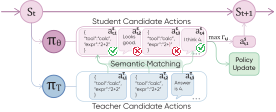
ActionOPD, an action-level on-policy distillation method, transfers decisions from black-box teachers through semantic agreement while the student learns through its own reasoning and responses.
Enlarge figure ↗Supervise the action, not its wording. ActionOPD transfers teacher decisions at states encountered by the student.
How ActionOPD works
ActionOPD starts from an objective: maximize the likelihood of teacher actions at student-encountered states. That likelihood is the total probability mass of student responses that realize the same semantic action, rather than reproduce one teacher-written sequence.
1
Sample decisions at the same state
Query a black-box teacher for three action samples and generate four candidate responses from the student.
2
Reward semantic agreement
Compare tool calls or user-facing messages, not reasoning text. Matching actions receive a reward, with a smaller bonus for additional teacher matches.
3
Advance once, learn from the group
Execute a highest-reward action to continue the trajectory. All candidates in retained groups contribute to the policy update.
Enlarge figure ↗One environment continuation, multiple candidate responses for learning.
The agreement objective yields a REINFORCE-form gradient. In practice, group-relative policy optimization trains the student's own reasoning and action tokens, without teacher token probabilities or tokenizer alignment.
Transfer beyond the training environments
Training on a curated pool of 6,697 AWM and EnvScaler tasks improves the four-benchmark average in all four student–teacher configurations, by 3.3–6.9 percentage points over the corresponding base models. Tau scores use the first four trials per task (trials 0–3).
Scaling with students and teachers
Larger students reach higher final averages. At both student sizes, DeepSeek-V4-Flash yields higher averages than Qwen3.7-Flash, demonstrating effective cross-family distillation without tokenizer alignment.
Four-benchmark average (%) after 100 training steps
Training teacher
Qwen3-4B
Qwen3-8B
Base (no distillation)
30.78
35.65
Qwen3.7-Flash
35.92 +5.14
38.97 +3.32
DeepSeek-V4-Flash
37.66+6.88
40.03+4.38
Enlarge figure ↗Student–teacher scaling in the tested configurations. Gains over Base use unrounded scores.
Competitive distillation, a flexible interface
We compare ActionOPD with offline distillation (KD) and sampled-token OPD on τ²-bench, using a Qwen3-4B student and Qwen3-32B teacher. All methods are evaluated after 50 training steps.
On held-out tasks, ActionOPD is close to OPD and ahead of KD on single-trial success (pass¹), but below both on success across all four trials (pass⁴). Its generation-only supervision offers a competitive alternative without teacher token log-probabilities or tokenizer alignment. The DeepSeek-to-Qwen results above separately demonstrate its cross-family applicability.
Domain average (%) · Four trials per task
Method
Train
Test
pass¹
pass⁴
pass¹
pass⁴
Base
26.3
6.9
29.2
7.5
KD
33.7
15.7
37.5
19.2
OPD
34.3
11.7
39.6
17.5
ActionOPD
37.9
13.7
40.0
14.2
Semantic supervision matters
Using the same 50-step Qwen3-4B / Qwen3-32B setup, we test three changes to ActionOPD:
Validity reward: train on action validity, retaining semantic scores for action selection.
Binary reward: remove the frequency bonus from training and action selection.
Random commit: keep semantic rewards, but select uniformly from all candidates.
ActionOPD leads in average single-trial success on training and held-out tasks, supporting the combined design. The largest drop comes from replacing semantic agreement with validity rewards.
Domain average (%) · Four trials per task
Method
Train
Test
pass¹
pass⁴
pass¹
pass⁴
Base
26.3
6.9
29.2
7.5
Validity reward
30.5
13.2
30.8
10.0
Binary reward
33.3
10.5
36.9
14.2
Random commit
33.2
9.2
37.5
12.5
ActionOPD
37.9
13.7
40.0
14.2
What changes in the agent's decisions?
Selected positive cases compare Qwen3-4B Base with the same student after 100 ActionOPD steps using DeepSeek-V4-Flash. Each pair shows a Base failure and an ActionOPD success on the same task and trial.
Following policy constraints
The user requests a flight change, but basic economy bookings cannot be modified.
Successes across four trials: 2/4 → 4/4
Qwen3-4B Base Failure
Reads that the booking is basic economy, yet modifies the flight through the API, violating the policy.
Qwen3-4B + ActionOPD Success
Explains the restriction and calls the transfer tool when the user requests escalation. The booking remains unchanged.
Prohibited modifications fall from 2/4 to 0/4. Success here means preserving a compliant booking, not completing a rebooking.
Tracking the correct target
Update the target order's address and speaker. Retrieve the new address in New York from a different source order.
Successes across four trials: 0/4 → 3/4
Qwen3-4B Base Failure
Treats the source order's New York address as if it already belonged to the target. Changes only the speaker, leaving the target address in Los Angeles.
Qwen3-4B + ActionOPD Success
Retrieves the source address, updates the target order's address, then changes the speaker.
The returned order contains both the New York address and the requested green speaker.
Completing and verifying actions
Restore service after an overdue-bill suspension and an unseated SIM. Payment alone does not reactivate the line.
Successes across four trials: 0/4 → 2/4
Qwen3-4B Base Failure
Promises restoration after payment but never calls resume_line. The user pays and reboots, but service remains disconnected and the agent transfers the case.
Qwen3-4B + ActionOPD Success
Recovers from an invalid tool call, resumes the line with resume_line, and guides the user to reseat the SIM.
User-side tool output confirms connection, and the evaluator verifies that the debt is cleared.
Can an agent supervise itself?
Self-ActionOPD uses the current Qwen3-4B model as both teacher and student, with independently sampled responses. The teacher receives privileged action guidance, private task information, and reference actions or target outcomes. The student uses only public interaction context.
After 50 steps, held-out average pass¹ and pass⁴ improve by 4.8 and 2.5 percentage points. The student retains these benefits when evaluated without privileged context, supporting the feasibility of action-level self-distillation.
Shared model weights Qwen3-4B
TeacherPrivileged task information
StudentPublic context only
Held-out τ²-bench average (%) · Four trials per task
Qwen3-4B
pass¹
pass⁴
Base
29.2
7.5
Self-ActionOPD
34.0
10.0
Citation
@misc{yuan2026actionopd,
  title  = {ActionOPD: Distilling Decisions, Not Tokens},
  author = {Yuan, Huining and Yi, Xiangmin and Xu, Zelai and Wang, Zixu
            and Chen, Xinlei and Zhang, Xiao-Ping and Wang, Yu and Yu, Chao},
  year   = {2026},
  eprint = {2610.19820},
  archivePrefix = {arXiv},
  url    = {https://arxiv.org/abs/2610.19820}
}
 Code
Code
 Models